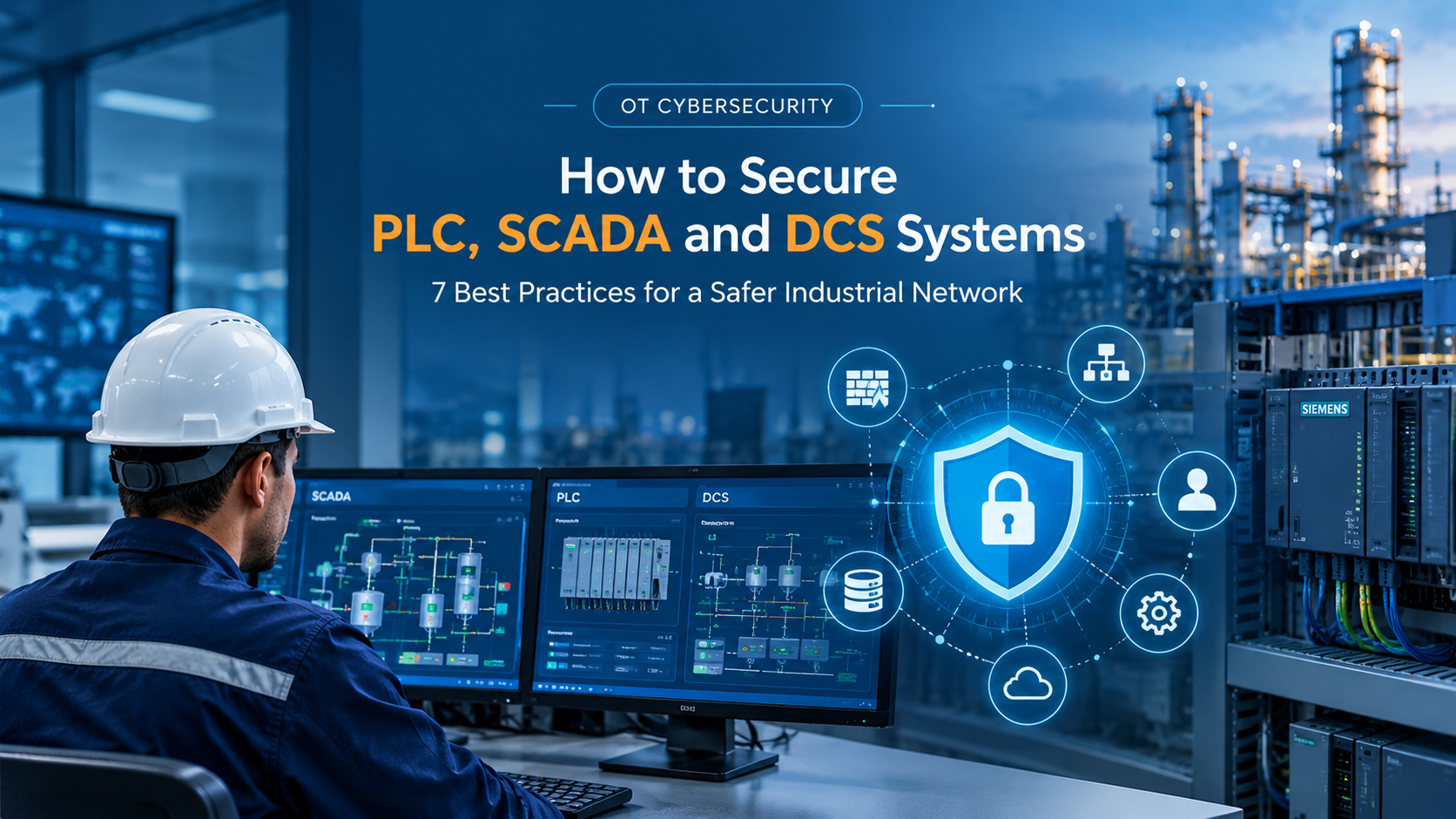
Industrial automation systems help manufacturers maintain production, control processes, and monitor equipment. However, connecting PLCs, SCADA systems, and DCS networks to business systems and remote access tools can introduce cybersecurity risks.
A security incident can affect production, equipment availability, process reliability, and operational safety. That is why industrial OT cybersecurity should be part of every plant's automation strategy.
In this guide, we explain seven practical ways to improve PLC, SCADA, and DCS security without overlooking the reliability requirements of industrial operations.
1. Understand Your Industrial Control System Network
The first step in securing an industrial control system is knowing which devices are connected to the network.
Create an inventory of:
PLCs, HMIs, SCADA servers, and DCS controllers
Engineering workstations and operator stations
Industrial switches, routers, and firewalls
Remote access connections and third-party devices
Software versions, firmware, and system dependencies
This inventory helps engineers identify outdated equipment, unnecessary connections, and potential security gaps.
2. Separate IT and OT Networks
Many plants connect their operational technology (OT) networks with corporate IT systems for reporting, production planning, and remote monitoring. If these networks are not properly separated, a security problem in one area may affect another.
Use industrial networking segmentation to limit communication between business networks and critical control equipment.
Practical measures include the following:
Separate network zones for controllers, operator stations, and enterprise systems
Firewalls between IT and OT environments
Controlled communication paths between network segments
A demilitarized zone (DMZ) where appropriate
Network architecture should be designed around the plant's control requirements and operational risks.
3. Secure Remote Access to PLC and SCADA Systems
Remote access helps engineers and approved service providers troubleshoot equipment without always travelling to the plant. However, poorly managed remote connections can expose critical systems.
To improve remote access security for industrial automation:
Disable remote connections that are no longer required.
Use VPNs and multi-factor authentication where supported.
Provide access only to authorized personnel.
Restrict vendor access to approved systems and time periods.
Record and review remote sessions.
Avoid exposing PLCs or SCADA interfaces directly to the public internet.
Remote access should be approved, monitored, and disabled when no longer needed.
4. Strengthen PLC, SCADA and DCS Access Controls
Weak passwords, shared accounts, and excessive user permissions can make unauthorized changes easier.
Apply role-based access control so operators, maintenance engineers, programmers, and administrators receive only the permissions required for their responsibilities.
For Siemens PLC environments, review the security features available in the specific controller and engineering software version. Protect project files, restrict programming access, and control who can download logic changes.
For SCADA and DCS systems, review user privileges, engineering access, alarm acknowledgements, and configuration-change permissions.
5. Maintain Backups and Manage Software Updates
A reliable recovery plan can reduce the impact of equipment failure, accidental changes, or a cybersecurity incident.
Keep secure backups of:
PLC programs and controller configurations
SCADA projects, graphics, and alarm configurations
DCS engineering projects and system settings
HMI applications and essential server configurations
Network configurations and relevant documentation
Store protected copies separately from production systems and test restoration procedures periodically.
Before installing patches or updating firmware, check compatibility and test changes in a suitable offline or test environment. Schedule approved changes during maintenance windows to reduce production risk.
6. Monitor Network Activity and Investigate Unusual Changes
Security controls are more effective when the plant team can identify unexpected activity.
Monitor relevant events such as:
Unusual communication between network zones
Repeated failed login attempts
Unexpected PLC logic or configuration changes
New devices connected to the OT network
Unapproved remote access sessions
Changes to critical SCADA and DCS settings
Establish a baseline of normal network behavior and define who will investigate alerts. Monitoring tools must be configured carefully so they do not interfere with time-sensitive industrial communications.
7. Follow an Industrial Cybersecurity Framework
A documented security process helps teams manage risks consistently rather than relying on individual settings.
The IEC 62443 industrial cybersecurity framework provides guidance for securing industrial automation and control systems. Its zones-and-conduits approach can help organizations define security boundaries and control communication between them.
Plants should also maintain an incident response plan, train relevant staff, review third-party access, and periodically reassess their security controls.
Security measures must be tailored to the system architecture, safety requirements, and operational environment. Avoid making untested changes to live control systems.
How Hive Automation Can Help
Hive Automation provides industrial networking and cybersecurity services for industrial control environments, alongside PLC programming, SCADA and HMI development, DCS engineering, and system upgrades.
Its industrial networking capabilities include network segmentation, firewall design, secure remote access, OT cybersecurity assessments, and IT/OT integration architecture.
Explore Hive Automation's Industrial Networking & Cybersecurity services to learn more.
Conclusion
Securing PLC, SCADA and DCS systems requires more than installing a firewall. Plants need clear network boundaries, controlled remote access, appropriate user permissions, tested backups, continuous monitoring, and a documented response plan.
Start by identifying your critical assets and reviewing the connections that can reach them. Then prioritize improvements according to operational risk and implement changes through a controlled engineering process.
Need to improve your plant's OT network security?
Contact Hive Automation to discuss industrial networking, control-system security, and automation modernization requirements.