Introduction
The pharmaceutical industry depends on precision, quality, safety, and strict regulatory compliance. From pharmaceutical manufacturing processes to equipment monitoring, every operation must follow established Good Manufacturing Practices (GMP).
However, one common challenge faced by pharmaceutical manufacturing facilities is equipment troubleshooting inside controlled cleanroom environments.
Imagine an automation engineer receiving an equipment alarm. To investigate the issue, the engineer may need to wear a cleanroom suit, complete the gowning procedure, enter a classified area, inspect the machine, identify the problem, and exit the cleanroom.
If the issue requires further investigation, the entire process may need to be repeated.
This creates additional coordination, consumes valuable engineering time, and can affect operational efficiency.
This is where modern pharma automation, PLC programming, SCADA systems, and remote monitoring solutions can make a meaningful difference.
Why Is Equipment Troubleshooting Challenging in Pharmaceutical Manufacturing?
Pharmaceutical manufacturing facilities operate under strict environmental and operational requirements. Cleanrooms are designed to maintain controlled conditions and minimize contamination risks.
Engineers and maintenance teams must follow approved entry procedures before accessing equipment located in classified areas.
Some common troubleshooting challenges include:
Repeated cleanroom gowning and degowning procedures.
Limited access to equipment during production.
Difficulty identifying machine faults quickly.
Delays in coordinating maintenance and automation teams.
Limited real-time visibility into equipment performance.
Additional time spent collecting process information.
Even a minor equipment issue can require significant time when physical access is necessary.
Implementing an effective pharmaceutical automation system can help reduce unnecessary manual intervention while maintaining operational and regulatory requirements.
5 Ways Pharma Automation Can Reduce Unnecessary Cleanroom Entry
1. Remote Monitoring Through SCADA Systems
A Supervisory Control and Data Acquisition (SCADA) system provides real-time visibility into industrial processes and equipment conditions.
In pharmaceutical manufacturing, a properly designed SCADA system can help engineers monitor:
Equipment operating status.
Temperature and pressure parameters.
Process alarms and notifications.
Motor and pump operating conditions.
Production process trends.
Historical equipment data.
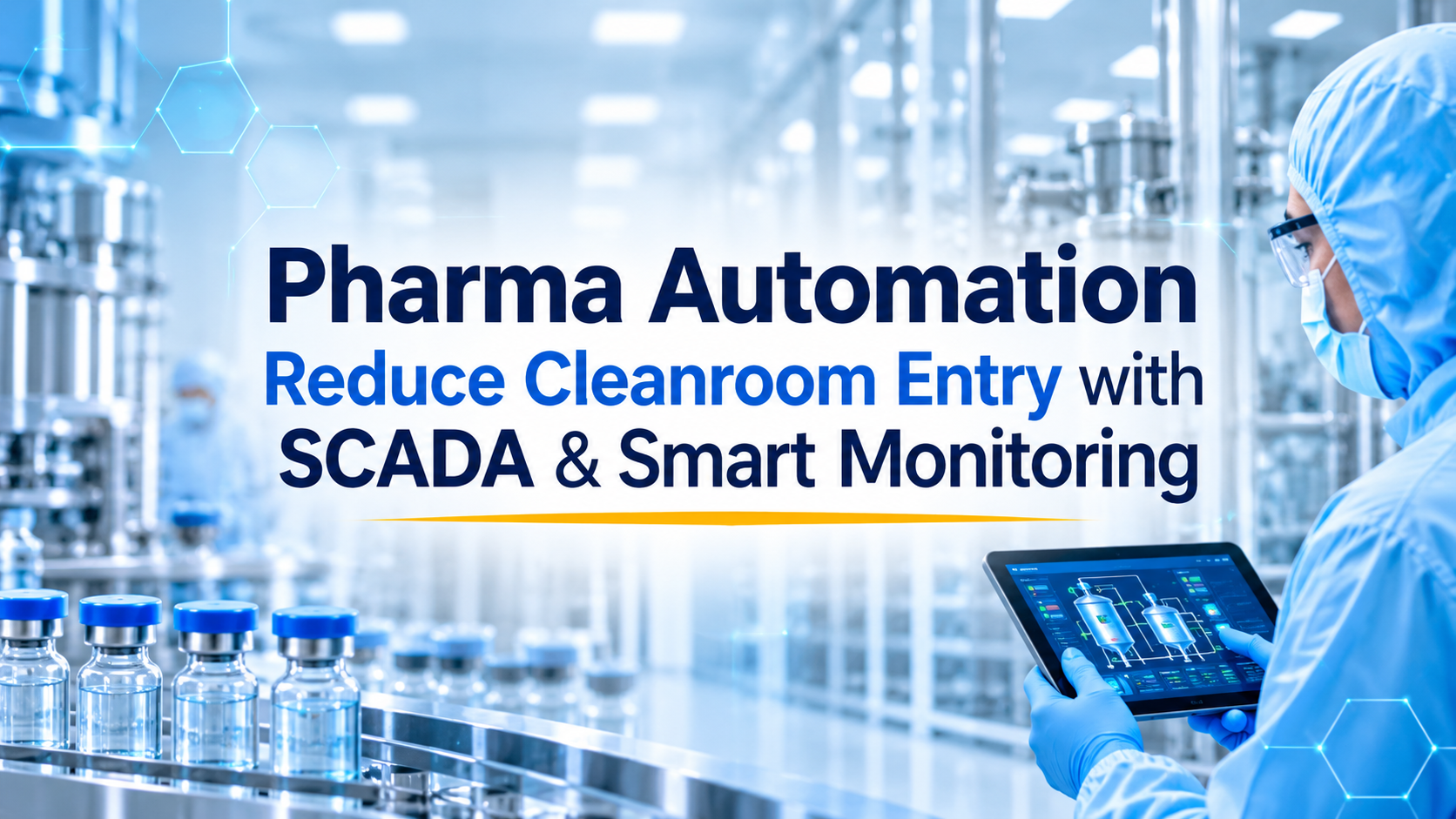
With appropriate system architecture and authorized access, engineers can investigate many operational issues without physically entering the cleanroom for an initial inspection.
A well-designed SCADA system in the pharmaceutical industry can improve process visibility and support faster troubleshooting.
2. Advanced Alarm Management for Faster Troubleshooting
Equipment alarms are essential for identifying abnormal operating conditions.
However, poorly configured alarm systems can create confusion and make troubleshooting more difficult.
Modern HMI and SCADA solutions can provide meaningful alarm information, including:
Alarm descriptions and priorities.
Equipment identification.
Alarm timestamps.
Historical alarm records.
Fault conditions and process status.
Event tracking and acknowledgement.
Better alarm management helps maintenance and automation engineers understand what happened and where further investigation is required.
This can reduce unnecessary physical inspections and improve equipment troubleshooting efficiency.
3. PLC Automation for Reliable Process Control
Programmable Logic Controllers (PLCs) are fundamental components of pharmaceutical manufacturing automation.
They control equipment sequences, process operations, interlocks, and machine logic.
A properly engineered PLC automation system can help pharmaceutical manufacturers achieve:
Consistent equipment operation.
Automated process sequences.
Reliable machine interlocking.
Improved equipment diagnostics.
Reduced manual intervention.
Better integration with HMI and SCADA systems.
Siemens PLC systems, including S7-1200 and S7-1500 platforms, can support different pharmaceutical process automation requirements.
When PLC programming is integrated with effective HMI and SCADA solutions, engineers gain better visibility into machine operations and troubleshooting information.
4. Historical Data and Process Monitoring
Sometimes, identifying an equipment problem requires more than checking its current operating condition.
Engineers may need to understand what happened before the alarm occurred.
Historical process data and trend monitoring can help identify:
Repeated equipment failures.
Abnormal temperature variations.
Pressure fluctuations.
Motor operating abnormalities.
Process deviations.
Recurring alarm conditions.
A suitable industrial data monitoring and reporting system can help engineers investigate these conditions using historical information.
For pharmaceutical manufacturers, process data also plays an important role in documentation, traceability, and operational review.
5. Remote Diagnostics and Authorized Remote Support
Remote diagnostics can help automation engineers investigate system conditions from designated engineering workstations.
Depending on the validated system architecture and approved site procedures, remote support may include:
Reviewing PLC diagnostic information.
Checking SCADA alarm history.
Monitoring equipment status.
Reviewing process trends.
Investigating communication errors.
Supporting authorized system maintenance.
Remote operation or control should only be implemented where permitted by the site's GMP, cybersecurity, validation, and access-control requirements.
Not every troubleshooting activity can be performed remotely. Physical inspection and maintenance will still be necessary for certain equipment issues.
Importance of GMP-Compliant Pharma Automation
In pharmaceutical manufacturing, automation is not simply about improving production speed.
It must also support product quality, process consistency, data integrity, and regulatory compliance.
A properly designed pharmaceutical automation system should consider:
GMP Compliance: Automation systems should support approved manufacturing procedures and applicable Good Manufacturing Practices.
21 CFR Part 11: Where applicable, electronic records and electronic signatures must meet relevant regulatory requirements.
Data Integrity: Process data, audit trails, and user activities should be managed according to applicable data integrity requirements.
System Validation: Automation systems should undergo appropriate qualification and validation activities based on their intended use and regulatory requirements.
Access Control: Only authorized personnel should access critical automation functions.
Industrial Cybersecurity: Remote connectivity and industrial networks should be designed with appropriate security measures.
These considerations are essential when implementing PLC, SCADA, HMI, and DCS solutions in pharmaceutical manufacturing facilities.
How Hive Automation Supports Pharmaceutical Industry Automation
Selecting the right industrial automation partner is an important decision for pharmaceutical manufacturers.
Hive Automation provides industrial automation engineering solutions focused on Siemens PLC programming, SCADA and HMI development, DCS integration, and turnkey automation projects.
Its pharmaceutical automation capabilities can support manufacturers and equipment OEMs in developing reliable and application-specific automation systems.
Key areas of expertise include:
1. Siemens PLC Programming
Custom PLC programming and integration for pharmaceutical equipment and process automation applications.
2. SCADA and HMI Development
Development of monitoring interfaces, alarm management systems, process visualization, and equipment status monitoring.
3. DCS Integration
Process control solutions for complex manufacturing operations requiring integrated and scalable control architecture.
4. Pharmaceutical Process Automation
Automation solutions for pharmaceutical process equipment, material handling, and manufacturing applications.
5. System Upgrades and Modernization
Upgrading existing automation systems to modern platforms to improve reliability, maintainability, and operational visibility.
6. Automation Project Execution
Engineering support covering system design, programming, testing, commissioning, documentation, and technical support.
Hive Automation also has experience with pharmaceutical automation projects involving GAMP 5-aligned systems, batch tracking, and GMP-oriented process automation.
Conclusion: Make Pharmaceutical Automation Work Smarter
The purpose of pharmaceutical automation should go beyond controlling machines and maintaining production operations.
It should also help engineers work more efficiently, improve equipment visibility, reduce unnecessary physical intervention, and support better troubleshooting decisions.
By implementing modern PLC automation, SCADA systems, HMI solutions, historical data monitoring, and authorized remote diagnostics, pharmaceutical manufacturers can make equipment troubleshooting more efficient.
However, every automation improvement must remain aligned with GMP requirements, validated system configurations, cybersecurity controls, and approved site procedures.
The real question is: Are pharmaceutical manufacturers designing automation systems only to control production, or are they also designing them to make everyday engineering operations easier?
If your pharmaceutical manufacturing facility is planning to upgrade its automation infrastructure, Hive Automation can help you explore suitable PLC, SCADA, HMI, and process automation solutions.
Explore industrial automation solutions with Hive Automation